
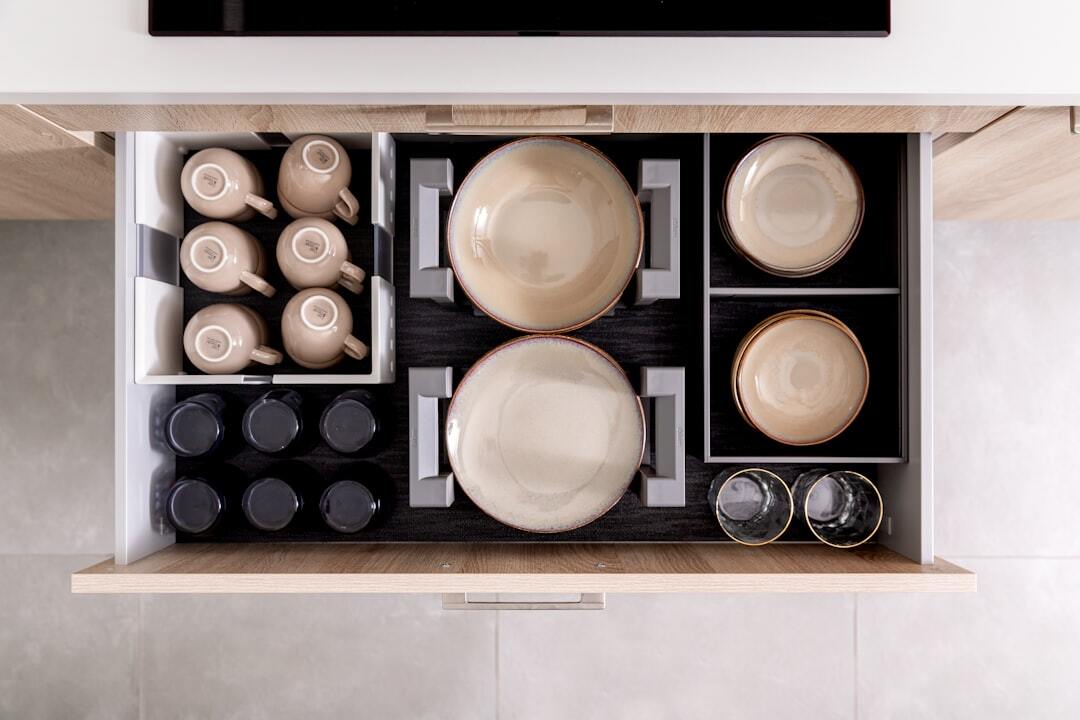
A well-organised kitchen can make everyday cooking, cleaning and putting away shopping noticeably easier. When everything has a logical place, you spend less time searching through crowded cupboards, food is less likely to be forgotten at the back, and the space you already have becomes far more useful.
The key is not simply buying more baskets, jars or cupboard organisers. Good kitchen organisation starts by removing what you no longer need, then arranging what remains around how you actually use the room.
Whether you have a compact kitchen with limited storage or plenty of cupboards that never seem to stay organised, a few practical changes can help maximise space and make the whole kitchen work more efficiently.
Start by Emptying and Decluttering Your Kitchen Cupboards
Before trying to organise anything, take everything out of the cupboard you are working on. It is difficult to judge how much storage you genuinely have when shelves are already filled with items that may no longer need to be there.
Check food for expired or long-forgotten products, identify duplicate ingredients and look honestly at gadgets, crockery and cookware that rarely get used. Containers without matching lids, chipped mugs, damaged utensils and appliances that have not been touched for years all take up valuable cupboard space.
Healthy organisation begins with deciding what deserves to stay. Donate usable items where appropriate, recycle what you can and dispose of anything that is no longer safe or useful.
Only once you know what actually needs storing should you start thinking about baskets, shelf risers or other organisers. Otherwise, there is a risk of simply buying products to organise clutter rather than creating more usable space.
Organise the Kitchen Around How You Actually Use It
One of the most effective ways to organise kitchen cupboards is to create zones based on everyday activities. Instead of filling whichever cupboard happens to have space, think about where an item is normally used.
Pots, pans and cooking utensils make sense close to the hob or oven. Plates, bowls and glasses can be positioned conveniently for serving food or unloading the dishwasher. Tea, coffee, mugs and related items are easier to manage together near the kettle, while baking ingredients and equipment work well close to the area where food is usually prepared.
The same principle applies to food storage. Breakfast ingredients can be grouped together, snacks can have their own area and frequently used cooking ingredients can sit near the main preparation zone.
This point-of-use approach reduces unnecessary movement around the kitchen and also makes it much easier for everyone in the household to understand where things belong.
Keep Everyday Items Within Easy Reach
Not every part of a kitchen cupboard is equally convenient, so use the most accessible areas for the things you reach for most often.
Everyday plates, mugs, glasses, ingredients and cooking equipment should generally sit between around waist and eye level where they can be reached without moving other items first. Less frequently used serving dishes, specialist appliances and seasonal cookware can usually be stored higher up or towards the back.
Heavy items are normally better placed on lower shelves, particularly cast-iron pans, large casserole dishes and bulky appliances. Apart from being easier to lift, this reduces the risk of pulling something heavy down from above shoulder height.
A useful rule is simple: the more frequently you use something, the easier it should be to reach.
Make Better Use of Vertical Cupboard Space
One of the biggest sources of wasted kitchen storage is the empty space above short items. A shelf may technically be full while half of its internal height remains completely unused.
Shelf risers can create an additional level for plates, bowls, tins or mugs without permanently changing the cupboard. Stackable containers can achieve something similar for dry food, while under-shelf baskets can make use of the space immediately beneath a shelf where suitable.
Extra shelving can also work well in particularly tall cupboards, provided there is enough clearance to remove items comfortably.
The aim is not to fill every centimetre. Overpacking shelves makes cupboards frustrating to use. Instead, use vertical space to reduce unnecessary stacking and make individual items easier to reach.
Stop Deep Cupboards Becoming Storage Black Holes
Deep cupboards often look generous but can be surprisingly inefficient. Items at the front hide everything behind them, and food or kitchen equipment can remain forgotten for months simply because it is difficult to see.
Pull-out baskets and sliding shelves are particularly effective because they bring the contents of the cupboard towards you rather than forcing you to reach into the back. In an existing kitchen where fitted pull-outs are not practical, removable baskets or trays can perform a similar job.
Grouping smaller items inside a shallow container also means the whole category can be pulled forward at once. Rather than searching individually for sachets, baking decorations or packets, you can remove one container and immediately see everything inside it.
Turntables can work well for jars, condiments and bottles, especially where reaching the rear corners is difficult.
Make Awkward Corner Cupboards Work Harder
Corner cupboards are notorious for wasting space. They often extend much further than the opening suggests, creating deep areas where small items disappear and larger items become difficult to retrieve.
Fitted carousel mechanisms and pull-out corner systems can dramatically improve accessibility in kitchens that already have them or where cabinetry is being upgraded. They allow much more of the cupboard contents to move towards the opening rather than remaining hidden around the corner.
There are simpler solutions too. Large turntables, removable baskets and clearly defined groups can prevent loose items from spreading through the cupboard. Corner units are often particularly suitable for larger cookware or appliances where fewer individual items need to be stored.
The important thing is to avoid treating a large corner cupboard as one enormous open container. Creating some form of internal structure makes the available space much easier to use.
Organise Food Cupboards So You Can See What You Have
Food cupboards are much easier to manage when similar products are stored together. Grouping tins, pasta, rice, cereals, baking ingredients, snacks, herbs and spices into clear categories makes it immediately obvious what you have and what needs replacing.
Visibility matters just as much as categorisation. Small packets positioned behind large boxes are easily forgotten, while half-open products can disappear beneath newer shopping and eventually be wasted.
Arrange shelves so smaller products remain visible and try to avoid placing several completely different categories in the same container simply because they happen to fit.
Keeping food organised also helps when writing shopping lists. If everything has a defined place, you can quickly check stock rather than buying another packet of something already hidden at the back of a cupboard.
Use Clear Containers and Labels Where They Actually Help
Clear storage containers can be useful for products such as flour, rice, pasta, cereals, pulses and baking ingredients, particularly when packaging is awkward or several half-used bags tend to accumulate.
Airtight containers may also help protect suitable dry ingredients once their original packaging has been opened. Labels are particularly useful where products look similar or when important preparation or expiry information needs to be retained.
There is no need to decant every supermarket product into matching jars simply because organised kitchens on social media often look that way. Keeping something in its original packaging can be perfectly practical if it stores neatly and remains easy to identify.
The best storage system is the one that makes your kitchen easier to use rather than simply more photogenic.
Use First In, First Out for Tins, Jars and Packets
When putting away new shopping, move older versions of the same product towards the front and place newer items behind them. This simple first-in, first-out system makes it more likely that older food will be used before its replacement.
It is particularly useful for tins, jars, sauces, packets and other cupboard staples that are regularly replenished.
A quick check while putting away groceries can also identify anything approaching its use-by or best-before date, helping reduce unnecessary food waste.
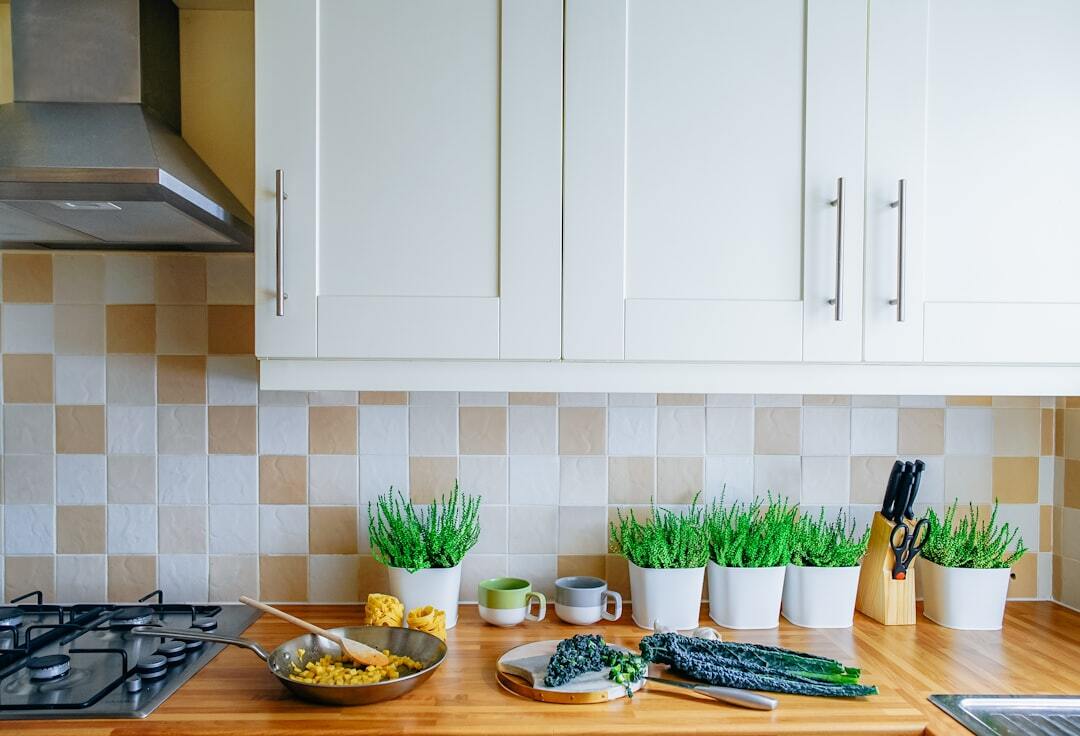
Store Pans, Trays and Lids Without Endless Unstacking
Pans, baking trays and lids consume a surprising amount of cupboard space, particularly when everything is stacked on top of everything else. The result may technically fit inside the cupboard but becomes frustrating every time the pan at the bottom is needed.
Nesting compatible saucepans can save space, but avoid creating towers so tall that several heavy items need to be removed each time you cook.
Vertical dividers work particularly well for baking trays, chopping boards, roasting tins and cooling racks. Storing these items upright means one can be removed without disturbing the others.
Pan lids can be stored separately in a rack or divider rather than balancing loosely on top of cookware. Some kitchens can also make use of suitable cupboard-door racks, provided the doors can still close comfortably and the fittings are designed to support the weight.
The goal should be accessibility as well as capacity. A cupboard is not efficiently organised if fitting one more pan inside makes everything else harder to use.
Use the Inside of Cupboard Doors for Extra Storage
The inside of a cupboard door is easily overlooked but can provide useful storage for lightweight or shallow items.
Depending on the cupboard, this could include a compact spice rack, measuring spoons, lightweight packets, cleaning cloths or other small organisers. It can be particularly useful in kitchens where shelf space is limited.
Measure carefully before installing anything. Door-mounted storage needs enough clearance to avoid hitting the shelves or their contents when the cupboard closes, and heavy organisers can place unnecessary strain on hinges.
Used selectively, cupboard doors can turn an otherwise wasted surface into useful additional storage without taking space away from the main shelf.
Don’t Forget the Cupboard Under the Sink
The cupboard beneath the sink is another area that can quickly become chaotic because pipework interrupts the available space and cleaning products tend to accumulate without much structure.
Removable baskets can group similar products together and make it easier to clean the cupboard itself. Smaller organisers can also make use of otherwise awkward areas around pipes, while frequently used products should remain towards the front.
Avoid keeping unnecessary duplicates simply because there is nowhere else obvious to put them. Three almost-empty bottles of the same cleaning product create the same storage problem as duplicated food elsewhere in the kitchen.
Households with children should also make sure potentially harmful cleaning products are stored securely and according to the product’s safety instructions rather than prioritising convenience alone.
Measure Before Buying Kitchen Cupboard Organisers
Storage products only save space when they actually fit the cupboard and solve a specific problem.
Before buying shelf risers, containers, turntables or pull-out organisers, measure the internal width, height and depth of the cupboard. Check the space between shelves and remember to account for hinges, doors and any handles or pipework that could restrict movement.
It is also worth deciding exactly what will be stored before buying an organiser. A beautifully designed container that wastes several centimetres around every edge may leave you with less usable space than you had before.
You do not necessarily need expensive storage systems either. Existing boxes, trays and containers can often be repurposed successfully once you know the dimensions and what the cupboard needs to hold.
Small Changes Can Make a Small Kitchen Feel More Spacious
When cupboard space is genuinely limited, prioritisation becomes particularly important. Keeping rarely used equipment in prime storage positions can make even a reasonable kitchen feel overcrowded.
Use higher shelves for occasional items, exploit vertical space where practical and choose cookware or food containers that stack efficiently. Moving something used only once or twice a year to another suitable storage area can also be more sensible than sacrificing everyday kitchen space for it.
Keeping worktops relatively clear can reinforce the feeling of space too. Appliances and accessories that are rarely used do not necessarily need permanent positions on the worktop if there is an appropriate cupboard available.
Small kitchens benefit especially from assigning every item a clear purpose and location. When storage is limited, allowing cupboards to become holding areas for miscellaneous possessions quickly consumes the space that really matters.
Create a Kitchen Cupboard System You Can Actually Maintain
A complicated organisation system may look impressive immediately after it has been created, but it is unlikely to last if putting something away becomes a chore.
Give each category an obvious home and make sure the arrangement makes sense to the people who use the kitchen. If everyone knows where mugs, snacks, baking equipment and cooking ingredients belong, there is much less chance of cupboards gradually returning to disorder.
Food cupboards also benefit from an occasional check for forgotten or expired products. This does not need to become a major reorganisation every month; a few minutes while putting away shopping is often enough to keep things under control.
As habits change, allow the kitchen to change with them. A cupboard that made sense several years ago may no longer be in the best location if the way you cook or use the room has changed.
A More Organised Kitchen Starts With the Space You Already Have
Maximising kitchen cupboard space does not necessarily mean adding more cabinetry or investing in an expensive redesign. In many kitchens, the biggest improvements come from making better use of the storage that is already there.
Decluttering first creates space immediately. Organising around everyday routines makes the kitchen more efficient, while shelf risers, pull-outs, dividers and carefully chosen containers can make previously wasted areas far more accessible.
Most importantly, good organisation should make daily life easier. You should be able to see what you have, reach what you use and put everything away without reorganising half the cupboard first.
When the system reflects the way your household actually uses the kitchen, staying organised becomes far easier — and the cupboards are much less likely to descend back into clutter a few weeks later.